Note on CASIA Multi-Spectral Palmprint Database
1.Introduction
In biometrics research, combing multiple imaging modalities has been proven to be a promising way to enhance performances of recognition. According to electromagnetic theory, hertzian waves ranging from visble light spectrum to near infrared provide increasing stronger penetravitity into objects. For hand biometrics, multi-spectrum illuminator can penetrate subcutaneous tissues at different depths in palm regions and form images of both surface skin textures and hypodemia (including palm veins). Based on this property, we design a multi-spectrum imaging device to capture correlative and complementary information of human hands.
CASIA Multi-Spectral Palmprint Image Database V1.0 (or CASIA-MS-PalmprintV1 for short) isreleased in order to promote research and progress on multiple spectral imaging of biometric modalities.
2. Brief Descriptions of the Database
CASIA Multi-Spectral Palmprint Image Database contains 7,200 palm images captured from 100 different people using a self-designed multiple spectral imaging device,as shown in Fig.1. All palm images are 8 bit gray-level JPEG files. For each hand, we capture two sessions of palm images. The time interval between the two sessions is more than one month. In each session, there are three samples. Each sample contain six palm images which are captured at the same time with six different electromagnetic spectrums. Wavelengthes of the illuminator corresponding to the six spectrum are 460nm,630nm,700nm,850nm,940nm and white light respectively. Between two samples, we allow a certain degree of variations of hand postures. Through that, we aim to increase diversity of intra-class samples and simulate practical use.
In our device, there are no pegs to restrict postures and positions of palms. Subjects are required to put his palm into the device and lay it before a uniform-colored background. The device supplies an evenly distributed illumination and captures palmt images using a CCD camera fixed on the bottom of the device. We design a control circuit to adjust spectrums automatically. Six typical palmprint images in the database are shown in Fig.2
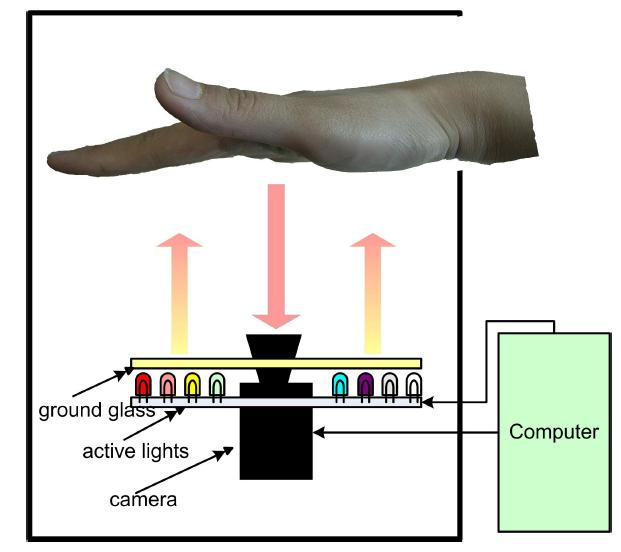
Figure 1 Our self-developed multi-spectral imaging device
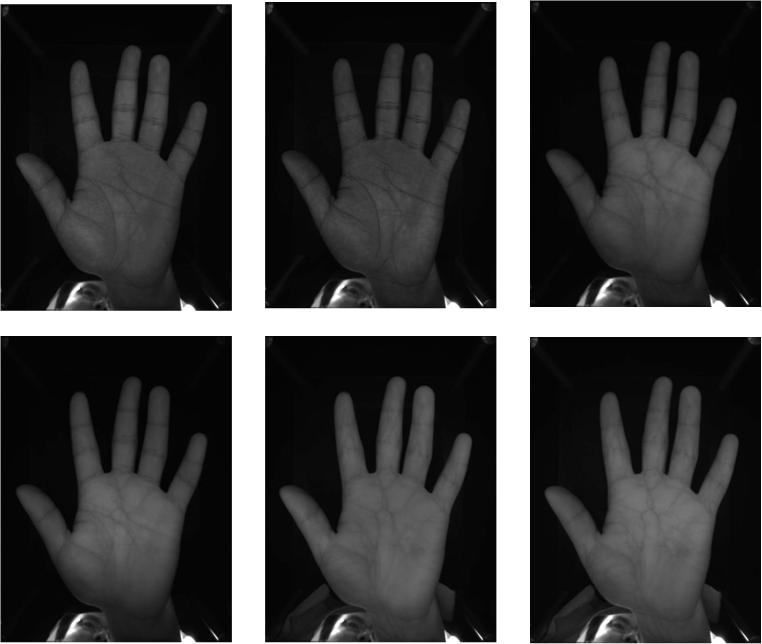
Figure 2 Six typical palmprint images in the database
3. Image Formats and Download Instructions
The images of the database are stored as:
XXX_(L/R)_YYY_ZZ.jpg
XXX: the unique identifier of people, ranges from 000 to 100.
(L/R): the type of palm, ‘L' denotes left palm and ‘R' denotes right palm
YYY: electromagnetic spectrums."WHT" represents the white light.
ZZ: the index of samples ranging from 01 to 06. 01 to 03 belong to the first session. 04 to 06 belong to the second session.
Researchers requesting this database should follow the following steps:
lVisit the website: http://biometrics.idealtest.org.
lRegister an account and login.
lDownload the CASIA Multi-Spectral Palmprint Database from our website with the authorized account:
CASIA Multi-Spectral Palmprint Database here.
4. Copyright Note and Contacts
The database is released for research and educational purposes. We hold no liability for any undesirable consequences of using the database. All rights of the CASIA database are reserved. Any person or organization is not permitted to distribute, publish, copy, or disseminate this database. In all documents and papers that report experimental results based on this database, our efforts in constructing the database should be acknowledged as: “ Portions of the research in this paper use the CASIA-MS-PalmprintV1 collected by the Chinese Academy of Sciences' Institute of Automation (CASIA) ” and a reference to "CASIA-MS-PalmprintV1, http://www.cbsr.ia.ac.cn/MS_Palmprint Database.asp" should be included. A copy of all reports and papers that are for public or general release that use the CASIA-MS-PalmprintV1 should be forwarded upon release or publication to
Professor Tieniu Tan
Center for Biometrics and Security Research
National Laboratory of Pattern Recognition
Institute of Automation , Chinese Academy of Sciences
P.O.Box 2728
Beijing 100190
China
or send electronic copies to znsun@nlpr.ia.ac.cn . Questions regarding this database can be addressed to Dr. Zhenan Sun at
Dr. Zhenan Sun
Center for Biometrics and Security Research
National Laboratory of Pattern Recognition
Institute of Automation , Chinese Academy of Sciences
P.O.Box 2728
Beijing 100190
China
Tel: +86 10 8261 0278
Fax: +86 10 6255 1993
Email: znsun@nlpr.ia.ac.cn
Publications:
[1] Ying Hao Zhenan Sun,Tieniu Tan and Chao Ren, "Multi-spectral palm image fusion for accurate contact-free palmprint recognition", Proceedings of IEEE International Conference on Image Processing, 2008, pp.281-284, USA .
[2] Ying Hao,Zhenan Sun,Tieniu Tan, "Comparative Studies on Multispectral Palm Image Fusion for Biometrics",?Proceedings of Asian Conferernce on Computer Vision 2007, vol.2, pp.12-21, Tokyo,Japan. |


 中文
中文




 Copy rigth All right reserved 2005 Center for Biometrics and Security Research